The 5th Gymnasium of Kavala (former Pasatzik Mansion)

Standing beside the old walls, with views over the harbour, the imposing building of today’s 5th Gymnasium of Kavala recalls the era when the city was a cosmopolitan centre. It was built in the early 20th century by the Turkish tobacco merchant Mehmet Ali Pasatzik and belongs to the wave of grand mansions built by the tobacco merchants of the time.

The three-storey building with the reddish façade, rising above the old town beneath the medieval walls, was once one of the most magnificent private residences in Kavala. It was built by Mehmet A. Pasatzik, a wealthy Ottoman landowner and tobacco merchant, at a time when the city’s rich businessmen competed to build the most impressive mansion. Today it houses the 5th Gymnasium (junior high school) and retains its historic and architectural character.

The Pasatzik residence was built between 1902 and 1907. It is symmetrical and three storeys high, with stone walls and neoclassical elements. Its architectural style combines Ottoman Neoclassicism with eclectic details, strongly reminiscent of European Art Nouveau and late Ottoman Baroque.

The building went up during the so-called “tobacco boom”, when Kavala’s great tobacco merchants, regardless of ethnicity, competed to build the most impressive residence. The Pasatzik house was among the most ornate and luxurious of its day.

History & Culture

The history of this mansion is closely woven into the modern history of Kavala. Mehmet A. Pasatzik, an Ottoman landowner and tobacco merchant, built it as his private residence in the early 20th century (completed around 1905). At that time, Kavala was a thriving centre of tobacco processing and trade, and merchants of various ethnic backgrounds competed over who would build the most impressive home, the Pasatzik mansion was one of the most distinctive.

After the Greek–Turkish Population Exchange of 1922–1923, the property was confiscated or ceded to the Greek state. The great house was soon used for public and official functions under Greek administration. During the interwar years it housed various services and institutions, the Prefecture of Kavala, a naval command, a naval school and, at times, a Commercial and Economic School. Even in that period, the building also served as a school, giving it a dual character: a centre of administration and, at the same time, a place of education. It thus became a hub of local social life during the 1920s and 1930s.

Before the Second World War, the mansion was used by the Greek police, a use that continued into the Occupation, when in 1941 the region passed under Bulgarian administration. During the Bulgarian Occupation (1941–1944), the building became the headquarters of the Bulgarian Security Police (the Ohrana). In those years it acquired a dark reputation: it was used as a place of detention and torture for members of the Greek resistance. The very name “Ohrana” became synonymous with fear for the local community, and the mansion’s role in those years left an indelible mark on the city’s memory.

After the end of the war, the building returned to public use, and over the years it took on a new role as an educational institution. In the late 20th century it was converted into a public school, and for roughly the last 45 years it has housed the 5th Gymnasium of Kavala. Its continuous use as a school has helped preserve it in excellent condition, making it at the same time a living monument.

Local Interest

The building stands beneath the medieval walls of Panagia and is notable for its architecture. Although it is not open to the public, it is a working school, its façade, with its neoclassical and decorative elements, is visible from the harbour and the surrounding lanes. It is one of the most characteristic urban buildings of 20th-century Kavala.

At the entrance, a commemorative plaque recalls the building’s past during the Occupation: “In this building, Greek patriots were imprisoned and tortured during the Bulgarian occupation (1941–1944).”

Although not a museum open to visitors, the 5th Gymnasium is an architectural and historical landmark. It is worth seeing as you walk through the old town, not only for its beauty, but for its connection with pivotal events in local and national history. For visitors interested in 20th-century Kavala, the Occupation and the city’s evolution, it is a place of particular significance.

Map

VISIT

5th High School of Kavala

Poulidou 20, Kavala 652 01

More Kavala Places

Panoramic view of Kavala from the sea

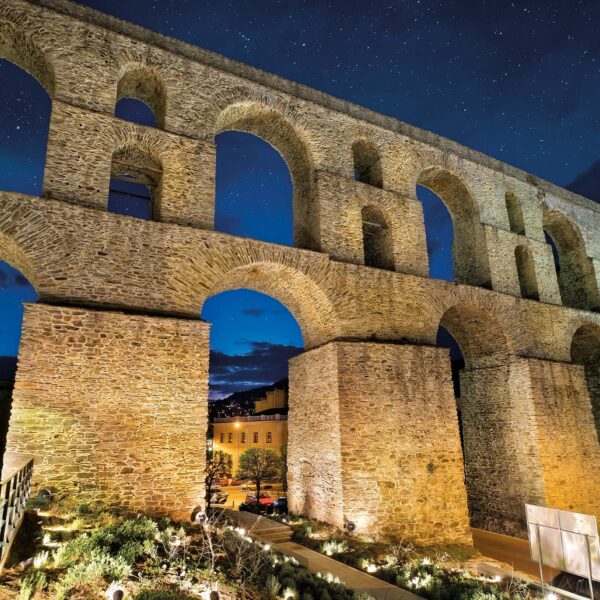
Old Aqueduct

The most characteristic monument of Kavala is the large, arched aqueduct, known by the name “Kamares” (Arches).
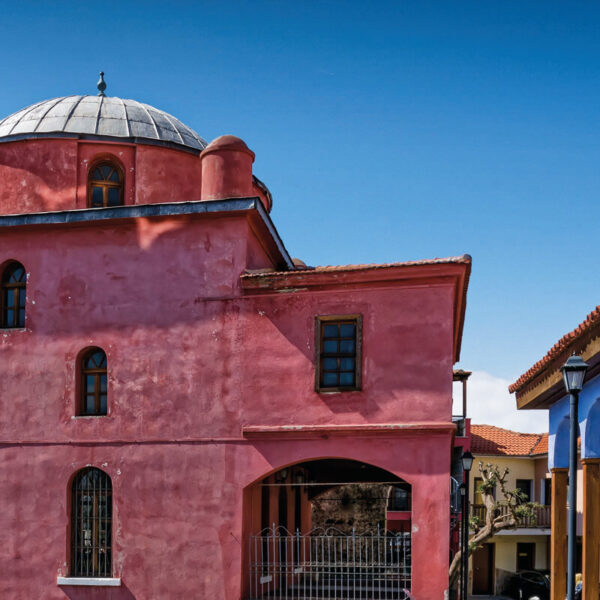
The Halil Bey Mosque, known as Palia Mousiki, in Kavala

Halil Bey Mosque

Near the Castle and on roads that lead to the acropolis.
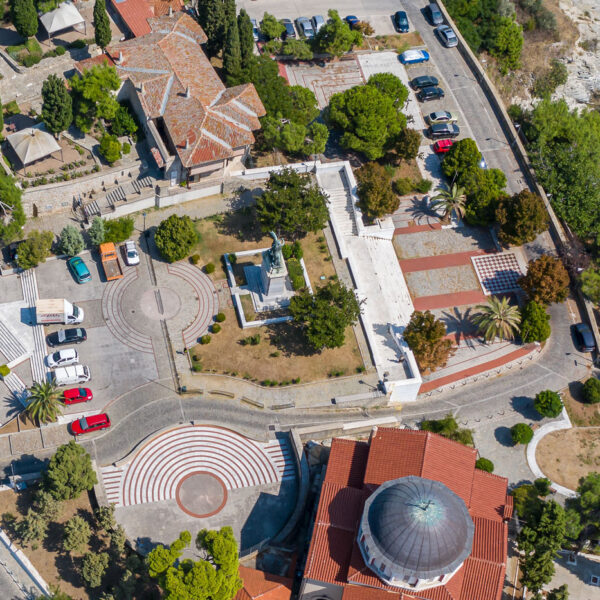
Mohammed Ali Square and the equestrian statue in Kavala

Mohammed Ali's Square

The square was formed in 1931 – 1934, in order to place the statue of Mohammed Ali.
Facebook
Twitter
LinkedIn
Pinterest